Showing posts with label Hawkins. Show all posts

Saturday, September 3, 2011

Salt of the Earth


This past summer I had the pleasure of working for an organization in western Michigan before going on tour and on one of the rare occasions I got to get away from camp to run into nearby Muskegon I passed a giant mount of sand (?) salt (?) something (?) and was instantly reminded of the work of one of the gallery’s artist, Tom Hawkins.

My poor imitation (it’s the sincerest form of flattery, right?):

2011-06-15 11.37.32


The real deal:

Salt Mound Bonaire

Salt Mound, Bonaire


Tom_Hawkins_Salt_Harvest_5_Bonaire_t

Salt Harvest #5, Bonaire


Salt Harvest No 3- Bonair

Salt Harvest #3, Bonaire


For information about Tom Hawkins or to see more of his work, check out his website here or contact the John Cleary Gallery here!

~Joseph

Saturday, April 9, 2011

It’s More than Just Black and White


For a continuation of our ongoing series regarding the different types of photography I thought today we’d take a look at three more well-known processes.

Gelatin Silver Print: As the dominant photographic mode from its inception in the 1880’s through the middle part of the 19th century, the silver gelatin print remains a mainstay in the black and white photography world.  The image is printed on paper coated with an emulsion of gelatin and silver salts.  Variations of types of paper and silver salt can effect the end product.

  • Silver chloride- used for contact printing, produces a generally neutral black
  • Silver bromide- used for enlargements, produces a bluish black or cool tone
  • Chloro-bromide- may be used for either, produces a warm, brownish black tone

day

Stanko Abadzic: A Day When Everything Goes Wrong, 2000/2008 (gelatin silver print)


Platinum and palladium print: Unlike the gelatin silver print, this process uses no emulsion and lies on the paper surface itself.  This results in a matte surface with a deposit of platinum/palladium absorbed slightly onto the paper and produces delicate rich tones and a range of grays that are unachievable in silver prints.  Palladium was introduced as a replacement for platinum paper during the advent of World War I when the price of platinum became too expensive.

Tom_Hawkins_Salt_Harvest_#5_Bonaire

Tom Hawkins: Salt Harvest #5: Bonaire, 1999 (platinum print)


Sepia and Selenium toned gelatin silver print: Toning is a common process used to change the color of black and white photographs using a chemical process carried out on silver-based prints by replacing the metallic silver in the emulsion with a silver compound. Toning can increase the range of visible shades in a print without reducing the contrast and can improve the chemical stability of the print, increasing its potential longevity. Sepia prints use silver sulfide resulting in a warmer tone, whereas selenium prints use silver selenide to produce a red-brown or purple-brown tone, depending on the strength of the solution.  
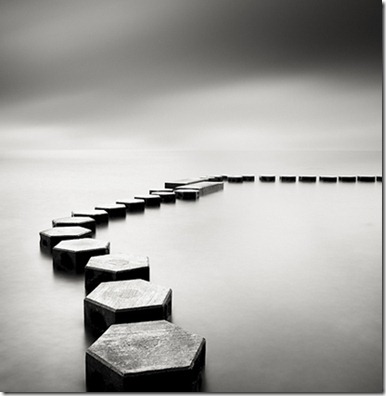
Josef_Hoflehner_Water_Walk_2007

Josef Hoflehner: Water Walk, 2007 (selenium toned gelatin silver print)


Joseph

Thursday, July 15, 2010

Found

Tom Hawkins
Obelisk and Meeting House:  Bonaire
platinum and palladium print 2000/2010

Found is an exhibition that brings recently discovered and emerging artists to the public eye and gives them a chance to display their work in a professional setting. This is the second Found exhibition the John Cleary Gallery has hosted. The artists selected to be in this show were hand picked by Catherine Couturier, the owner of the John Cleary Gallery, for their uniqueness, quality, and craftsmanship. The artists in Found were discovered in Houston’s FotoFest and New Orlean’s PhotoNOLA.


Michael Donnor
Elizabeth
waxed gelatin silver print


FotoFest’s portfolio reviews at the Meeting Place occur biennially and PhotoNOLA’s portfolio reviews take place annually. Both events offer the opportunity for artists to get their work exposure and for the reviewers to see the latest and most contemporary work not yet on the market. These mutually beneficial experiences were the catalyst behind Found.


John Chervinsky
All Watched Over
archival pigment ink, 2005

Found features artists who hail from as far away as Switzerland to as close by as Houston. Artists selected to be in the exhibition are Darryl Baird, Edward Eakins, EJ Major, Elaine Ling, Ferit Kuyas, Gerald Pisarzowski, Isa Leshko, Jessica Somers, John Chervinsky, John D’Agostino, Michael Donnor, Niniane Kelley, Robert Covington, Renate Aller, Tom Hawkins, and Trudy Cohen. Found will be each artist’s first exhibition at the John Cleary Gallery.

John D'Agostino
The Arms of Undertow
archival pigment ink on canvas, 2008

Come by the gallery and see what we Found!